Is The Marketing Funnel Dead? Meet the Chaos Spiral That Actually Converts
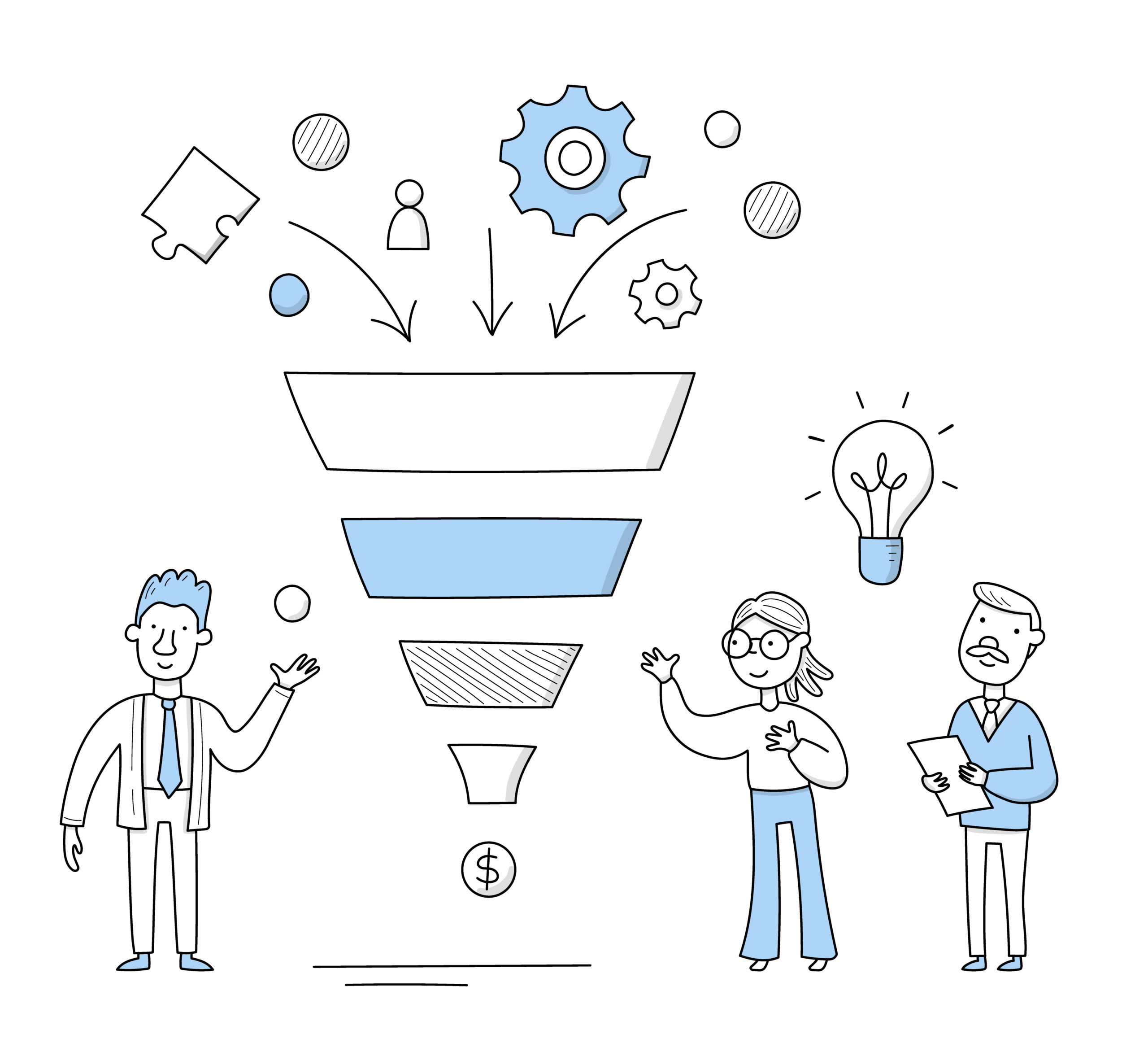
Business funnel concept with people and sales funnel. Vector doodle illustration of internet marketing strategy, diagram of online customer traffic management
Once upon a time, marketing was tidy, predictable, and polite in a way that now feels almost fictional. People saw an ad, they clicked the ad, they bought the thing, and everyone involved felt very professional about the whole experience. That was the marketing funnel, and it worked beautifully in a world where attention wasn’t being attacked from every direction at once.
Then the internet grew up, got loud, multiplied, learned how to shout in twelve formats at the same time, and politely set the funnel on fire.
Now your customer sees your post on Instagram, forgets you exist for three weeks, hears your name on a podcast while doing dishes, Googles you at 1:17 a.m. because something you said stuck in their brain, reads three reviews and one angry Reddit thread, decides to “think about it,” buys nothing, gets your email two weeks later while standing in line for coffee, clicks out of boredom, and finally buys because the timing suddenly feels right.
That is not a funnel. It’s more like a life spiral. And for most modern buying decisions, that messy, looping path is what tends to convert best.
Funnels assume people behave logically, calmly, and in a straight line from curiosity to credit card. Real humans behave emotionally, impulsively, skeptically, distractedly, and occasionally while half-asleep with a phone balanced on their face. Funnels say Awareness leads to Interest, Interest leads to Desire, and Desire leads to Action. Real life looks more like Curiosity leads to Ignore, Ignore leads to Mild Intrigue, Mild Intrigue gets interrupted by a group text, Obsession fades into Doubt, Doubt becomes quiet stalking, stalking becomes ghosting, and ghosting suddenly becomes buying when the mood is right.
Funnels want control. People want freedom. And when your marketing tries too hard to guide, nudge, or “optimize” them, they quietly leave through the back door without making a scene.
Enter the Chaos Spiral.
The Chaos Spiral is not a strategy you design. It is a reality you either fight or learn how to work with. People do not move through your content in order. They show up on different platforms at different times, consume things out of sequence, skip the post you worked on for three days, and fall in love with the weird offhand comment you almost didn’t publish. They make buying decisions emotionally and then build logical reasons afterward so they can feel like responsible adults.
They spiral around your brand, slowly building familiarity, trust, curiosity, and a quiet emotional connection that grows in tiny moments you never get to see. One day, they buy, and it feels sudden to you, like magic or luck or a fluke. It wasn’t. It was the twenty-seven small encounters that came before that moment, quietly stacking on top of each other until the decision felt obvious to them.
The Chaos Spiral converts because it matches human behavior instead of fighting it. People don’t move forward in straight lines. They orbit things that interest them. Every time someone sees your name, reads your story, laughs at your joke, feels understood, or learns something useful, they move one inch closer. Not down a funnel, but around a spiral. Your job is not to shove them forward. Your job is to give them enough good reasons to keep circling.
That means showing up often enough that people keep bumping into you like an old friend at Target. Not in a creepy way. In a familiar way. The kind where they think, “Oh hey, them again,” instead of, “Why is this person following me into every app I open?” Familiarity builds comfort. Comfort builds trust. Trust opens wallets without drama.
It also means accepting that nobody is reading carefully. They are scrolling emotionally. They want short ideas, clear points, strong opinions, and lines that stick in their head long after they’ve forgotten where they saw them. You are not competing with other marketers. You are competing with snacks, notifications, work stress, family group chats, and a video of a dog doing something illegal with a vacuum cleaner.
Selling in the Chaos Spiral doesn’t look like shouting or pressure. People don’t hate offers. They hate feeling trapped. Instead of commanding people to buy, you let curiosity do the heavy lifting. You show what changed, what worked, what failed, what surprised you, and what made you rethink things. Curiosity feels like freedom. Pressure feels like a trap door.
You also repeat yourself more than feels comfortable, because if you are bored of saying something, your audience is just starting to hear it. Same message, new stories. Same idea, different moods. Same lesson, different mistakes. The Chaos Spiral runs on gentle reminders, not dramatic speeches.
And most of all, you let people decide in their own time. Some buy fast. Some need weeks. Some watch silently like emotional raccoons, observing everything and saying nothing until the moment feels right. Your job is not to rush them. It is to still be there when they are ready.
Funnels try to control people. Chaos Spirals respect them. Funnels try to move people. Chaos Spirals attract them. Funnels feel like pressure. Chaos Spirals feel like permission. People don’t want to be led. They want to feel like they found you.
And when they feel like they chose you, they stay longer, trust deeper, and buy better.
The real marketing secret is not a perfect funnel, a complicated map, or a 37-step customer journey. It is clear ideas, consistent presence, a human voice, real stories, and patience. Marketing is not about guiding people down a pipe. It is about becoming a place they like to orbit.
Let them circle. Let them wander. Let them come back.
Because in the end, the people who buy are never the ones you chased. They are the ones who stayed close long enough to trust you.